
Solar Quote Checklist: 12 Things to Check
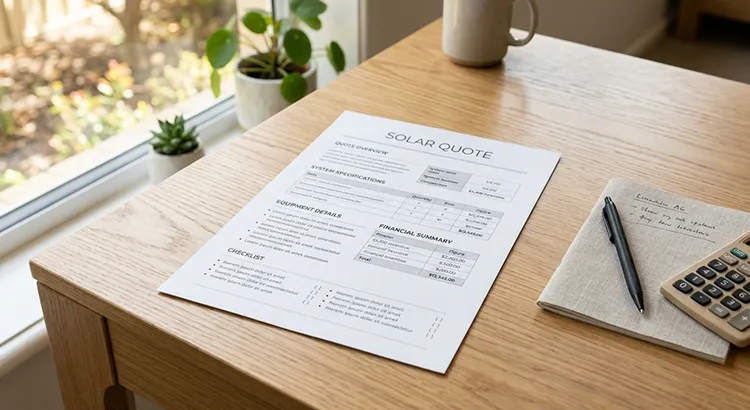
Getting multiple solar quotes is a sensible way to compare systems, pricing and potential savings. However, the headline price does not tell you everything you need to know. A quote should clearly set out the system specifications, applicable rebates, compliance requirements, warranties and the assumptions behind its savings estimates.
For Perth homeowners, this is particularly important following the changes that came into effect on 1 May 2026. Knowing what to look for can help you identify outdated information and compare quotes on a like-for-like basis.
Things to Check on a Solar Quote
Before choosing a solar system, go beyond the total price and check what is actually included in the quote. These 12 points cover the key compliance, equipment, accreditation and commercial details worth reviewing.
1. Check the Commissioning Standard
A 2026 solar quote should reference AS/NZS 4777.2:2020 and the applicable Australia Region B settings for inverter commissioning. This is an important detail following the changes introduced on 1 May 2026.
If the quote makes no reference to the relevant commissioning standard, it is worth asking the installer to clarify what standard will apply. Compliance should be part of the quoted system rather than something left to be addressed later.
2. Confirm the Export Pathway
The quote should identify which export pathway the proposed system will use. New and upgraded systems can use either the Future-Ready (CSIP-AUS) pathway or the Fixed 1.5 kW export option.
For most metro Perth homes, the Future-Ready pathway is the relevant option because it maintains full DEBS access and VPP eligibility. The quote should make the selected pathway clear instead of simply stating that the system is communications-ready.
3. Check the Federal STC Calculation
The federal battery rebate structure changed on 1 May 2026, with STCs moving to tiered values. The first 14 kWh of usable battery capacity attracts roughly $244/kWh, compared with around $311/kWh under the earlier structure, with lower rates applying above that level.
Check that the quote uses the post-1-May values. A quote based on the previous flat STC calculation can make the rebate appear higher than it actually is.
4. Check the WA Battery Scheme Rebate and VPP Requirement
If the quote includes a battery, it should show the applicable WA Residential Battery Scheme rebate. The rebate is up to $1,300 for Synergy customers and up to $3,800 for Horizon Power customers.
The quote should also address VPP enrolment, which is a condition of the rebate. If the battery rebate is shown but there is no mention of the VPP requirement, ask the installer to clarify how the scheme requirements are being met.
5. Check the Aggregate Inverter Capacity
The new standard connection allows up to 30 kVA of aggregate inverter capacity. A detailed quote should account for the inverter capacity of the proposed solar and battery system, along with any future EV-charger inverter capacity where applicable.
If the proposed capacity exceeds the standard limit, the quote should identify that an engineering escalation is required. Be cautious of quotes that still refer to a blanket 5 kW single-phase cap, as this reflects older assumptions.
6. Check the Inverter Make, Model and Listing
The inverter should be identified by its make and model, rather than being described with a general term such as “premium inverter”. The quote should also confirm that the inverter is CEC-listed.
For battery systems, check that the selected inverter is included on the relevant Synergy or Horizon Power Supported Solutions List where applicable. Having the exact model makes it possible to understand precisely what equipment is being offered.
7. Check the Battery’s Usable Capacity
Battery capacity should be stated in usable kWh, rather than relying only on nominal capacity. The usable figure represents the capacity available for powering the home.
The battery should also appear on the CEC approved list. The difference between nominal and usable capacity can be significant, so checking the usable figure helps you make a more accurate comparison between different quotes.
8. Check the Solar Panel Specifications
The panel specification should include more than its wattage. The quote should identify the panel make and model, along with its temperature coefficient.
This is particularly relevant in Perth, where high temperatures can affect panel output. A quote that simply says, for example, “440W panels” does not provide enough information to understand the equipment being proposed or how it is expected to perform in hot conditions.
9. Check the Installer’s Accreditation
Check whether the retailer is a CEC Approved Solar Retailer and whether the installation will be carried out by a licensed electrician. These details should be identifiable from the quote.
Accreditation and licensing are important when assessing the eligibility of the installation for applicable rebates. The installer should be able to provide the relevant details rather than leaving you to make assumptions about who will carry out the work.
10. Check for Itemised Pricing
A single total price makes it difficult to understand what you are actually paying for. A good quote should break down the major components and costs.
Look for separate pricing for items such as the solar panels, inverter, battery, mounting and electrical work. Rebates should also be clearly shown as deductions. This makes it easier to compare quotes and check whether the advertised rebate has been correctly applied.
11. Check the Warranties in Writing
A solar quote should distinguish between the workmanship warranty provided by the installer and the product warranties provided by manufacturers.
Both should be stated in writing, including their respective durations. A general assurance that “everything is covered” does not provide the same clarity as having the actual warranty terms documented in the quote.
12. Check the Basis of the Generation and Savings Estimates
Savings projections can look attractive, but the assumptions behind them matter. Check whether the quote clearly explains the basis of its generation and savings calculations.
Be cautious of estimates that assume you will use all of your solar generation yourself or receive high export returns throughout the day. A credible quote should state assumptions such as the self-consumption rate and tariff and account for the fact that midday exports under DEBS earn roughly 2c/kWh.
Final Thoughts on Comparing Solar Quotes
A solar quote should give you enough information to understand exactly what you are buying and how the quoted price and savings have been calculated. Checking the commissioning requirements, export pathway, rebate calculations, equipment specifications and accreditation can help identify quotes based on outdated assumptions.
It is also worth comparing the commercial details, including itemised costs and written warranties. When quotes are assessed on the same basis, differences in price become easier to understand and you can see whether a cheaper option reflects genuinely lower costs or differences in equipment, compliance or warranty coverage.
Looking for a Solar Quote in Perth for Your Home?
Fritts Solar provides tailored solar solutions for Perth homes based on your energy needs and property. Our team can help you understand your system options, equipment and applicable rebates before you make a decision. Get a detailed solar quote in Perth and take the next step towards a suitable solar system for your home.